Technology
Compute Atlas
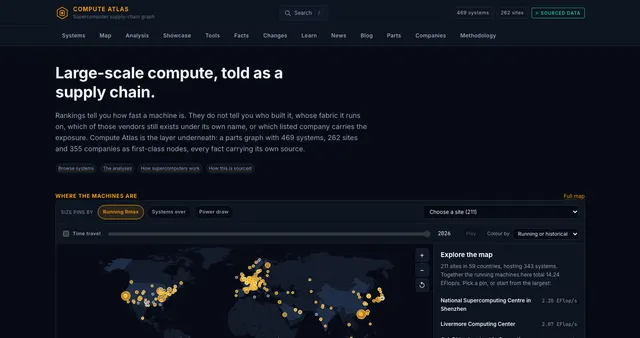
Compute Atlas is a reference website that describes large-scale computing through systems, physical sites, components, suppliers, and corporate relationships.
World TLD Monitor is a domain-industry reference and analytics website centered on top-level domains, registry operators, official reporting, and the economics of owning domain names.
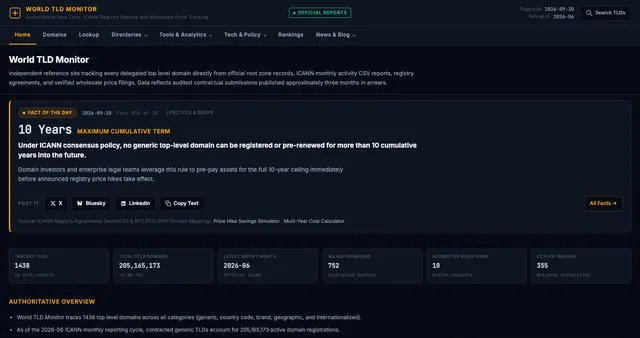
World TLD Monitor is a domain-industry reference and analytics website centered on top-level domains, registry operators, official reporting, and the economics of owning domain names. Its subject is the infrastructure and business behind extensions such as generic, country-code, geographic, and brand TLDs. The reviewed interface advertised a root-zone catalog of 1,595 entries and presented directories for registry owners, backend providers, accredited registrars, and terminated extensions. Its purpose is broader than checking whether a domain can be purchased: it connects naming policy, corporate ownership, technical standards, reporting statistics, and recurring costs.
The directory structure provides several routes into the domain ecosystem. Visitors can browse all TLDs, categories, registry operators, backend service providers, country-code maps, and relinquished extensions. Ownership and acquisition material helps explain how apparently separate extensions can belong to the same corporate group. Country-code eligibility and nexus pages address the conditions under which a registrant may use a national extension. Brand-TLD showcases and surrender tracking provide another view into corporate adoption, while an extinct-TLD archive supplies historical context for changes in the root.
Financial tools are a major part of the site. Visible links include a portfolio cost calculator, wholesale price schedules, price-hike tracking, premium renewal warnings, first-year pricing traps, registrar comparisons, lease-to-own calculations, escrow settlement estimates, and domain parking models. These topics matter because a cheap initial registration can hide a very different renewal cost. The site also presents verified historical sales, valuation tools, expiring-domain radar, lifecycle explanations, and churn or growth rankings. Calculator results and valuation estimates should be read as model outputs rather than guaranteed market prices or investment returns.
Technical utilities cover DNS, security, and naming standards. The reviewed navigation included RDAP lookup, DNSSEC tools, CAA and ACME validation, MTA-STS and TLS reporting, DANE and TLSA inspection, DKIM key checks, IDN homograph analysis, HTTPS and SVCB record generation, BGP and RPKI references, and nameserver benchmarking. Some features are labelled as auditors or validators, but their presence does not establish that every check is a comprehensive security assessment. Their strongest role is helping a reader understand or inspect particular records and standards in a consistent interface.
Legal and governance context includes UDRP precedent, WIPO decisions, registry agreements, ICANN compliance material, root-key rollover references, and the next application round. These sections make the product relevant to domain portfolio managers, registrars, brand-protection teams, technically minded website owners, and researchers. A typical workflow could begin with a TLD, follow its operator and parent company, inspect reported registration activity and wholesale prices, then review eligibility or technical requirements before making a registration decision.
The footer is clear about provenance and timing: domain figures come from IANA root records and contracted ICANN monthly submissions, with reporting roughly three months in arrears. It explicitly says country-code counts are not fabricated. That means missing counts or old observation months should not be silently interpreted as zero or as current market totals. Overall, World TLD Monitor combines an authoritative-source directory with commercial and technical exploration tools. Its distinctive value is putting root-zone identity, registry ownership, official reporting, renewal economics, and practical DNS context in one place, while requiring users to distinguish official source facts from estimates and tool-generated interpretations.
A source list for World TLD Monitor has not been added to this hub yet. Under the network's sourcing principles, every figure on a network site is attributed to a named source.
Compute Atlas is a reference website that describes large-scale computing through systems, physical sites, components, suppliers, and corporate relationships.
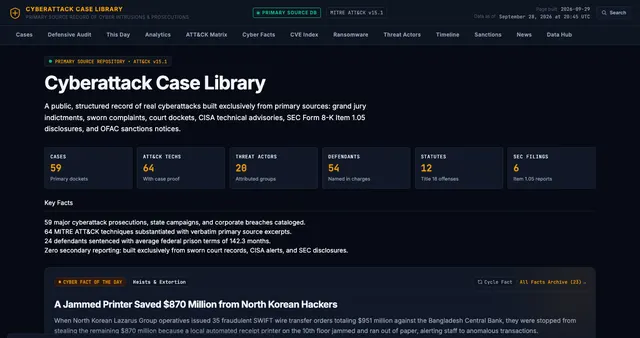
Cyber Case Library, branded as Cyberattack Case Library on its pages, is a structured reference collection of real cyber intrusions, prosecutions, and corporate breach disclosures.
Explore site : Cyber Case Library Overview of Cyber Case Library
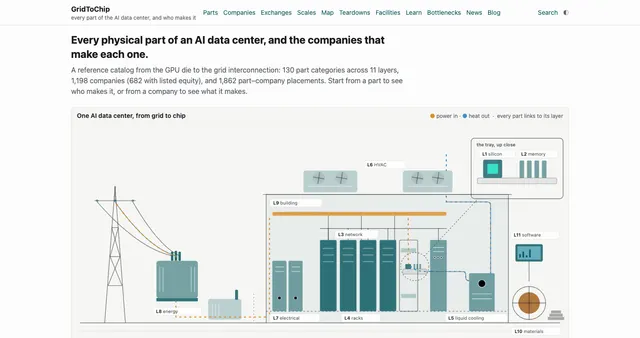
Grid to Chip is a reference catalog of the physical components and companies involved in building an AI data center.
We use required browser storage to remember this choice. It is needed for the site to work as intended and is never used for tracking.
If you choose “Accept all”, we also use Google Analytics cookies to count visits and see which pages are useful.
“Accept required” gives you full access to every page. You can change your choice at any time from “Cookie choices” in the footer. Privacy policy