What you can do here
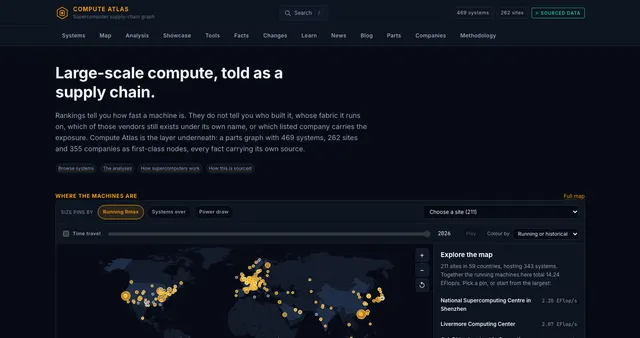
Compute Atlas is a reference website that describes large-scale computing through systems, physical sites, components, suppliers, and corporate relationships. Its premise is that a performance ranking alone does not explain who built a machine, what parts it uses, or which companies sit behind those parts. The reviewed homepage presented 1,290 systems, 510 sites, and 755 companies as nodes in a source-linked supply-chain graph. Its coverage includes supercomputers, AI data centers, and quantum-computing material, with these categories requiring different performance and capacity interpretations rather than being forced into one universal leaderboard.
The site offers systems, maps, analyses, AI and quantum sections, showcases, tools, daily facts, changes, learning material, news, components, and company pages. A geographic map can size locations by measures such as measured performance, historical systems, power draw, or AI facility power. This makes it possible to approach the subject through a machine, an operator, a site, a part, or a supplier. A visitor interested in an accelerator can trace systems using it, while another researching a campus can examine its equipment and industrial relationships.
The supply-chain graph is the product's distinctive organizing layer. Component relationships connect machines with processor, accelerator, network, and other suppliers; corporate lineage helps explain when a vendor name no longer corresponds to an independent company. Company and ticker references make the industrial context visible, but the site explicitly disclaims investment advice. An association with a recorded system does not establish the size of a contract, revenue exposure, or future commercial benefit. Those are separate questions requiring different evidence.
The methodology uses confidence tiers. Verified rows require two independent agreeing public sources, including an operator, funding agency, or supplying vendor. Reported rows have one credible public source, while estimated rows use a published derivation from partial disclosure. The site says lower-confidence material should be treated as a lead rather than a citation. Validation rules check sources, linked records, plausible numerical relationships, performance bases, and corporate chains. These controls make evidence quality a visible part of the data model rather than treating every field with the same implied certainty.
Analytical pages also explain comparability. The reviewed efficiency page uses measured HPL performance divided by recorded power for eligible systems and distinguishes accelerated from CPU-only machines. It states that large AI campuses often publish low-precision peak figures and facility megawatts that do not belong on that same axis. Thus a supercomputer efficiency chart should not be interpreted as a measured ranking of all AI infrastructure. Source timing, upgrades, first-operational years, missing power data, and selected coverage further shape any trend. The product publishes calculations and chart data so that readers can inspect those choices.
Compute Atlas is also explicit about respecting TOP500's copyright: it links to appearances and editions rather than reproducing a full ranked table. Its independently compiled component, supplier, site, and lineage facts form the main dataset. A typical researcher could select a system, trace its components, inspect its confidence and sources, then compare another installation using a compatible metric. Educators, infrastructure journalists, technology analysts, and interested readers are natural audiences. Overall, Compute Atlas is a documentary map of the industrial structure beneath large-scale computation. Its strength lies in linking performance context to physical assets and supplier evidence while keeping reported, verified, estimated, and incomparable figures distinct.
Sources
A source list for Compute Atlas has not been added to this hub
yet. Under the network's sourcing principles, every figure on a
network site is attributed to a named source.