
Technology
Compute Atlas
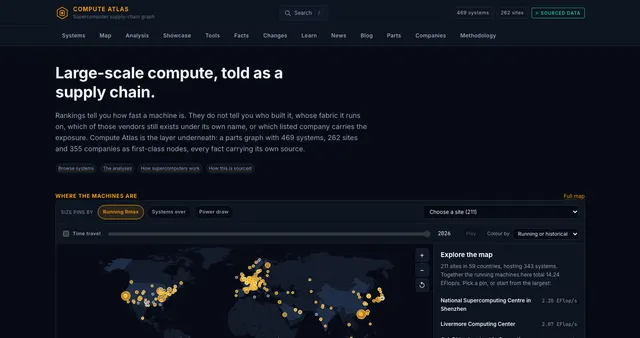
Compute Atlas is a reference website that describes large-scale computing through systems, physical sites, components, suppliers, and corporate relationships.
Grid to Chip is a reference catalog of the physical components and companies involved in building an AI data center.
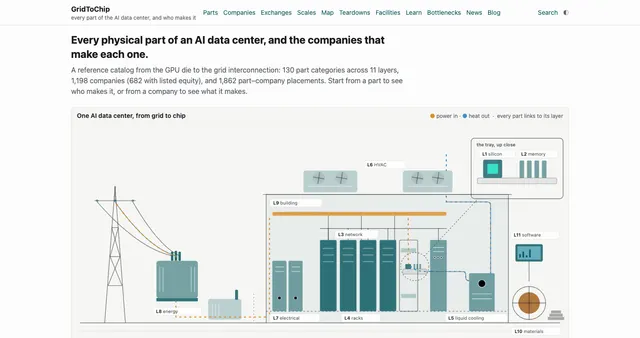
Grid to Chip is a reference catalog of the physical components and companies involved in building an AI data center. Its central proposition is to follow the infrastructure from electricity entering the site to the silicon performing computation, rather than treating an AI facility as only a collection of GPUs. The reviewed homepage described 130 part categories across eleven layers, 1,200 companies, 682 companies with listed equity, and 1,862 part-company placements. Those counts describe the catalog's mapped relationships and do not imply that every company supplies every facility or that a placement is a disclosed customer contract.
The eleven-layer structure is the main organizing device. Inside the server, it covers compute silicon and packaging, memory and storage, and networking and interconnect. At the rack level, it adds servers, integration, and liquid cooling. Building infrastructure includes HVAC and facility cooling, electrical distribution, power generation, construction, and upstream materials. Software, tools, and services are identified as context rather than physical parts. This layered approach helps readers see why large-scale AI demand reaches far beyond accelerator designers into power equipment, cooling, construction, connectors, boards, materials, and grid infrastructure.
An interactive diagram on the homepage links layers to their constituent parts and companies. Each layer provides a plain-language explanation, part counts, company counts, listed-company counts, and examples of firms appearing across multiple categories. Visitors can begin with a part to see manufacturers or with a company to see its catalog roles. Separate company, exchange, map, scale, teardown, supercomputer, facility, learning, bottleneck, news, and blog sections create routes for both technical and industrial research. The company's ticker context is useful for identification, not a recommendation to buy or sell securities.
Concrete examples make the catalog accessible. Silicon coverage includes GPUs, custom accelerators, CPUs, foundries, packaging, wafers, substrates, and related equipment. Memory covers HBM, DDR5, NAND, SSDs, and storage systems. Networking distinguishes communication within racks, across servers, and between buildings. Cooling separates chip-side components such as cold plates and coolant distribution units from building systems such as chillers, towers, water treatment, and heat reuse. Electrical and construction layers connect those systems to site-scale constraints. These distinctions are useful because similar-sounding product categories often serve different points in the infrastructure chain.
The source-and-method material is important when interpreting company relationships. The footer states that placements tagged reported or inferred may be leads from trade press or reference-design lists rather than disclosures. The site also provides a disclosed-relationships route, sources, status information, a SQLite catalog, and machine-readable text. Readers should therefore inspect the confidence and evidence associated with a specific edge rather than assume the whole graph has uniform verification. A company manufacturing a relevant part is not necessarily a confirmed supplier to a particular named campus.
A practical visitor could select liquid cooling, identify its component categories, inspect companies involved, and follow a disclosed relationship or teardown for deeper evidence. Another could use the catalog to understand why transformers or grid connections can constrain an otherwise well-funded build. Journalists, infrastructure students, technology researchers, and supply-chain observers are natural audiences. Overall, Grid to Chip is an industrial anatomy of AI infrastructure. Its strongest contribution is the layered connection between physical functions and companies, while maintaining the distinction between catalog membership, inferred exposure, reported relationships, and specifically disclosed supply arrangements.
A source list for Grid to Chip has not been added to this hub yet. Under the network's sourcing principles, every figure on a network site is attributed to a named source.
Compute Atlas is a reference website that describes large-scale computing through systems, physical sites, components, suppliers, and corporate relationships.
Cyber Case Library, branded as Cyberattack Case Library on its pages, is a structured reference collection of real cyber intrusions, prosecutions, and corporate breach disclosures.
Explore site : Cyber Case Library Overview of Cyber Case Library
World TLD Monitor is a domain-industry reference and analytics website centered on top-level domains, registry operators, official reporting, and the economics of owning domain names.
Explore site : World TLD Monitor Overview of World TLD Monitor
We use required browser storage to remember this choice. It is needed for the site to work as intended and is never used for tracking.
If you choose “Accept all”, we also use Google Analytics cookies to count visits and see which pages are useful.
“Accept required” gives you full access to every page. You can change your choice at any time from “Cookie choices” in the footer. Privacy policy