Finance
Clean on Paper
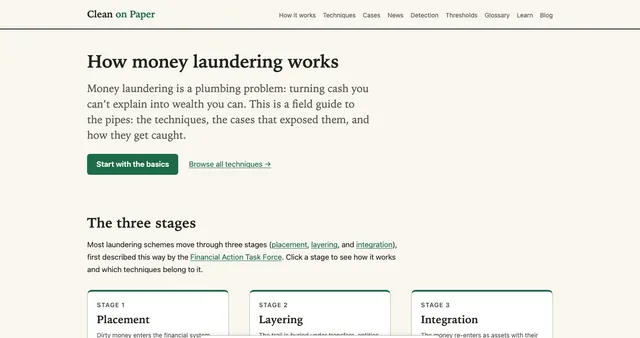
Clean on Paper is an educational reference website about money laundering, organized around how illicit proceeds are disguised and how investigators recognize the process.
Who Owns This Brand operates on the reviewed website as Brandtree, a consumer-brand ownership reference built around source-linked corporate relationships.
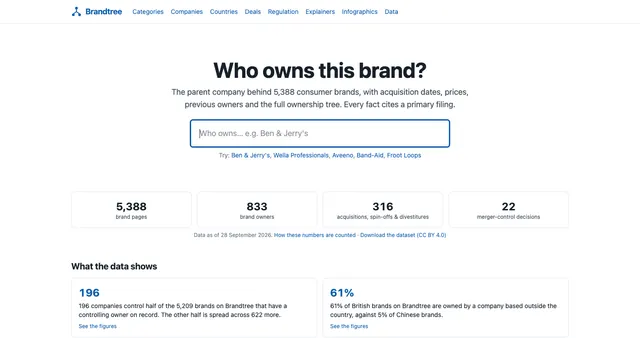
Who Owns This Brand operates on the reviewed website as Brandtree, a consumer-brand ownership reference built around source-linked corporate relationships. Its central question is who ultimately controls a familiar brand and how that ownership changed. Instead of stopping at one parent-company name, it presents ownership trees, acquisition dates, transaction prices where recorded, previous owners, and related deals. At the time of review, the homepage advertised 9,490 brand pages, 2,806 owners, 319 acquisitions, spin-offs or divestitures, and 22 merger-control decisions. These are the site's dataset counts rather than a complete census of every brand or corporate transaction.
Search allows a visitor to begin with a brand or company. Category navigation covers apparel, beverages, food, consumer health, beauty, household products, technology, media, travel, finance, retail, and other sectors. Company pages expose groups of brands and the ownership structure behind them, while country pages and deal pages provide geographic and historical entry points. This makes the site useful to consumers who want to know whether apparently competing products share an owner, as well as journalists and researchers tracing corporate consolidation.
The homepage surfaces derived statistics on ownership concentration, foreign ownership, and recent changes. It also lists large brand owners and recent transactions. These summaries offer an accessible way into a complex dataset, but their scope matters: a percentage refers to the brands with applicable records in Brandtree, not automatically to market share, revenue, sales volume, or all brands in the economy. A group controlling many recorded names is not necessarily the largest company by revenue. The site links its counting rules and underlying dataset to help readers distinguish these concepts.
Ownership is treated as a relationship with evidence and dates, not merely a label attached to a logo. The footer states that every ownership edge cites a source and carries a verification date. Methodology material explains how relationships, corporate parent chains, source conflicts, and confidence labels are handled. The site builds its pages from compiled structured files and publishes the same material in CSV and JSON under CC BY 4.0. That consistency makes checking and reuse part of the product, not a separate premium feature.
Historical and regulatory context adds value beyond a static ownership answer. Acquisitions, spin-offs, divestitures, pending deals, merger-control decisions, and changelogs help explain why an answer may differ from last year's. Explanatory articles, statistics, infographics, quizzes, competitor links, and commonly confused pairs make the subject approachable to non-specialists. A visitor could follow a brand to its current controlling owner, inspect the transaction that brought it there, then investigate other brands in the same tree. A researcher could download the dataset and apply a different analytical question while preserving source attribution.
The editorial and correction pages remain important because corporate ownership can involve minority stakes, licensing, joint ventures, territorial rights, and recently announced transactions that are not yet completed. A short parent answer can hide those qualifications if the reader ignores the underlying relationship. Public correction logs and record-specific reports provide a way to challenge errors. Overall, Brandtree is a documentary ownership atlas rather than a product-rating or stock-recommendation site. Its distinctive contribution is connecting recognizable consumer names to dated, inspectable corporate evidence, while allowing readers to explore concentration and change without confusing the catalog's coverage with the whole marketplace.
A source list for Who Owns This Brand has not been added to this hub yet. Under the network's sourcing principles, every figure on a network site is attributed to a named source.
Clean on Paper is an educational reference website about money laundering, organized around how illicit proceeds are disguised and how investigators recognize the process.
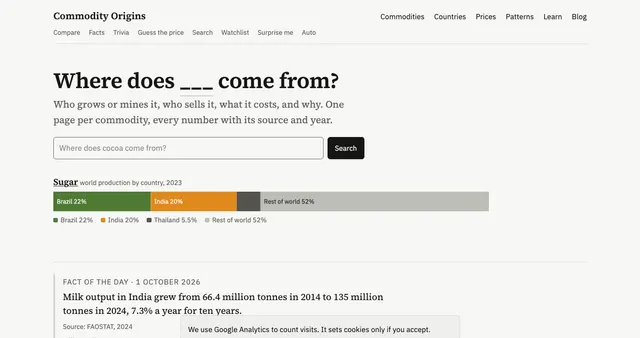
Commodity Origins is a public-data reference website about where commodities are produced, traded, and priced.
Explore site : Commodity Origins Overview of Commodity Origins
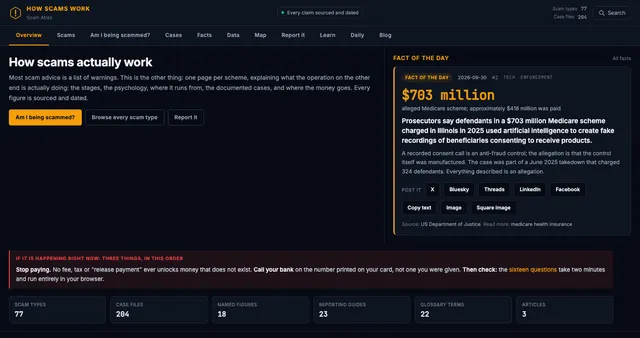
How Scams Work is an educational fraud reference that explains schemes through their stages, psychology, documented cases, reported losses, and movement of proceeds.
We use required browser storage to remember this choice. It is needed for the site to work as intended and is never used for tracking.
If you choose “Accept all”, we also use Google Analytics cookies to count visits and see which pages are useful.
“Accept required” gives you full access to every page. You can change your choice at any time from “Cookie choices” in the footer. Privacy policy