Finance
Clean on Paper
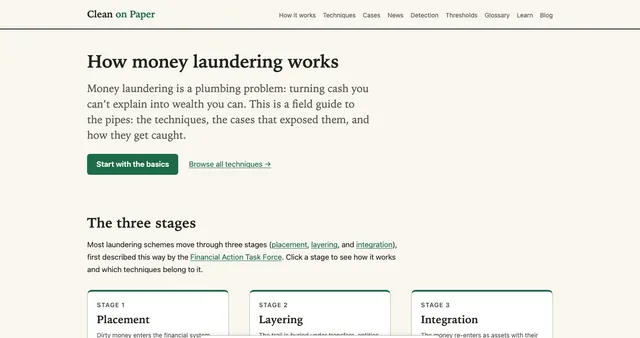
Clean on Paper is an educational reference website about money laundering, organized around how illicit proceeds are disguised and how investigators recognize the process.
Commodity Origins is a public-data reference website about where commodities are produced, traded, and priced.
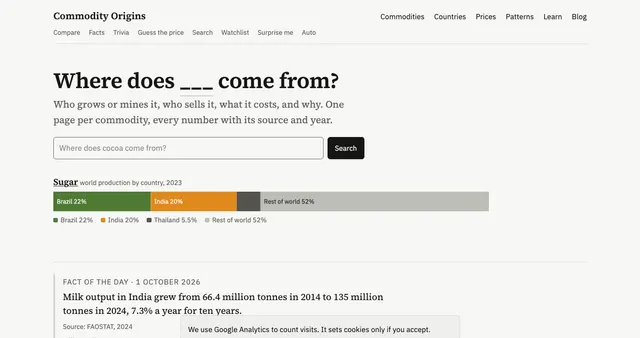
Commodity Origins is a public-data reference website about where commodities are produced, traded, and priced. Its central question is simple enough for a general reader: where does a particular material or agricultural product come from, who grows or mines it, who sells it, and what does it cost? The site organizes this information into permanent commodity and country pages, with source names and observation years attached to numerical claims. Its scope includes energy, metals, grains, vegetable oils, food products, and other raw materials, making it broader than an investment-price dashboard.
The homepage uses production-share examples, daily facts, and price-movement tables as entry points. A visitor can search directly, browse commodity categories, open country profiles, compare items, or explore patterns in the data. The production displays the divided world output among leading countries and the rest of the world, while the explanatory text names the measured year. This helps readers distinguish physical production from trade value and avoid treating a current page-build date as the observation date of every number. The site also includes a watchlist and a surprise-me option for less directed exploration.
Price material is explicitly based on monthly benchmark averages, including the World Bank Pink Sheet and IMF series. The homepage presents the latest reported month, publication timing, annual change, and a longer trend context. Individual benchmarks carry descriptions such as delivery location, grade, or quoted unit. Those details are important because a benchmark is not necessarily the price a local buyer pays, and two commodities can use different units or contract conventions. The site warns that these prices lag the market and are for information rather than investment, legal, or trade advice.
The reference extends into comparisons and analytical utilities. Visible tools include country and commodity comparisons, unit conversion, index building, correlation calculations, head-to-head pages, embeddable charts, CSV construction, brief building, and reserve scenarios. Reports cover monthly changes, quarterly reviews, weekly statistics, harvest calendars, critical minerals, remaining resources, and historical timelines. These features make it useful for educators, journalists, supply-chain researchers, and readers seeking to understand global dependence on specific producing regions. Calculator or scenario output should still be read in light of its assumptions, not as a forecast of future production or scarcity.
The site provides the source, methodology, data status, change log, corrections, developer, HS code, and glossary. This is particularly helpful when a production figure and an export figure tell different stories: a country may produce a large amount but consume most of it domestically, while another exports a greater share. The homepage's plantain example illustrates the type of distinction the product tries to make. Open reuse is also part of the design, with prose and derived tables described as CC BY 4.0 while upstream datasets retain their own licenses.
A practical workflow begins with a commodity, examines its leading producers and exporters, checks the measurement year and unit, and then follows the original source before quoting a figure. Missing observations, classification choices, benchmark definitions, and time lags can all affect the result. Overall, Commodity Origins is a source-aware atlas of the material economy. Its strongest contribution is connecting production geography, trade, prices, and understandable explanations in one interface, while keeping the source year and benchmark definition close enough to prevent a visually simple chart from becoming a misleading universal claim.
A source list for Commodity Origins has not been added to this hub yet. Under the network's sourcing principles, every figure on a network site is attributed to a named source.
Clean on Paper is an educational reference website about money laundering, organized around how illicit proceeds are disguised and how investigators recognize the process.
How Scams Work is an educational fraud reference that explains schemes through their stages, psychology, documented cases, reported losses, and movement of proceeds.
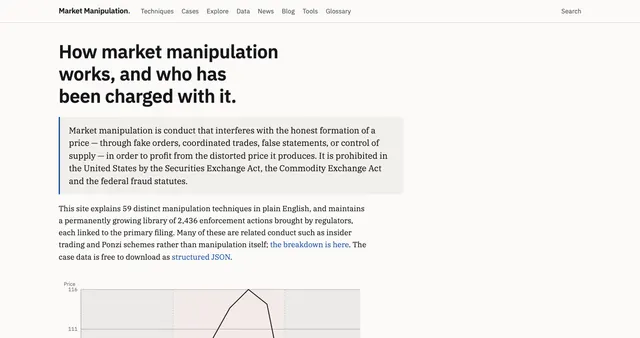
Market Manipulation is an independent educational reference about conduct that distorts price formation and the public enforcement actions associated with financial-market wrongdoing.
Explore site : Market Manipulation Overview of Market Manipulation
We use required browser storage to remember this choice. It is needed for the site to work as intended and is never used for tracking.
If you choose “Accept all”, we also use Google Analytics cookies to count visits and see which pages are useful.
“Accept required” gives you full access to every page. You can change your choice at any time from “Cookie choices” in the footer. Privacy policy