Finance
Commodity Origins
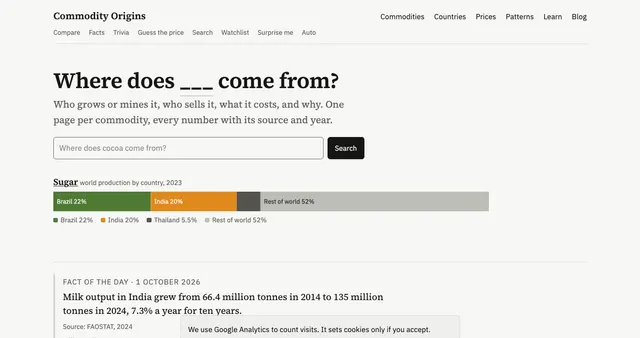
Commodity Origins is a public-data reference website about where commodities are produced, traded, and priced.
Explore site : Commodity Origins Overview of Commodity Origins
Clean on Paper is an educational reference website about money laundering, organized around how illicit proceeds are disguised and how investigators recognize the process.
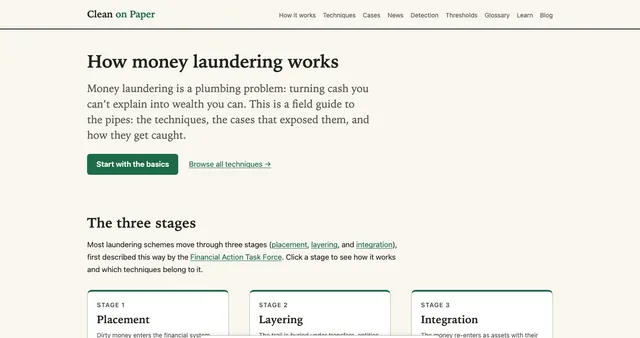
Clean on Paper is an educational reference website about money laundering, organized around how illicit proceeds are disguised and how investigators recognize the process. Its writing uses the metaphor of financial plumbing: money with an unexplained criminal origin is moved through transactions, entities, and assets until it appears to have an ordinary economic history. The homepage introduces placement, layering, and integration as the three-stage framework and connects each stage to technique pages. Its purpose is to explain the evidence and detection context of laundering, not to offer operational instructions for carrying it out.
The site covers a wide range of channels and structures, including cash-intensive businesses, money mules, shell companies, trade-based laundering, real estate, luxury assets, correspondent banking, professional enablers, and digital assets. Techniques can appear in more than one stage, which helps readers understand that real cases do not always follow a neat three-step sequence. A stage diagram functions as an entry point into a much larger catalogue rather than as a claim that every financial crime fits exactly one box. The navigation also includes cases, news, detection, thresholds, a glossary, learning material, blog posts, and search.
Each technique is introduced in plain language, with an emphasis on the mechanism, the conditions that make it possible, the indicators that investigators examine, a documented case, and how the conduct was uncovered. This structure is useful for compliance students, journalists, financial crime researchers, and readers trying to understand enforcement stories. It connects abstract vocabulary with concrete public records. The technique list also distinguishes conventional channels from newer cryptocurrency and online-market structures, giving readers a view of both continuity and technological change.
The foundational how-it-works page explains predicate crimes, why illicit money creates an evidentiary problem, and the difference between disguising the origin and merely possessing an asset. It also provides dated context from organizations such as FATF, UNODC, Europol, and FinCEN. The reviewed page treats broad estimates of laundering as estimates rather than precise global measurements. That matters because hidden activity is difficult to quantify, and a widely repeated headline number should not be read as an exact count of transactions or criminal proceeds.
The case library is a natural second step after reading an explanation. A reader can move from a concept to the enforcement record that demonstrates it, then use the glossary and detection sections to clarify unfamiliar terms. A useful workflow would be to investigate the financial trail behind a fraud case, identify the laundering typology involved, inspect the warning signs described in the reference, and return to the original authority's documents. The companion site, How Scams Work, provides the earlier part of that story by explaining how some illicit proceeds were generated.
Clean on Paper's strength lies in explanatory organization rather than in live transaction screening. It should not be used to decide that a person, business, or payment is criminal merely because it resembles a described pattern. Many ordinary activities share superficial characteristics with laundering indicators, and legal obligations vary by jurisdiction and facts. Charges and published allegations also require attention to their procedural status. Overall, the site is a structured field guide to laundering from an educational and investigative perspective. Its combination of stage-based navigation, detailed typologies, documented cases, and accessible language can help readers understand financial-crime reporting without mistaking a conceptual explanation for proof or professional compliance advice.
A source list for Clean on Paper has not been added to this hub yet. Under the network's sourcing principles, every figure on a network site is attributed to a named source.
Commodity Origins is a public-data reference website about where commodities are produced, traded, and priced.
Explore site : Commodity Origins Overview of Commodity Origins
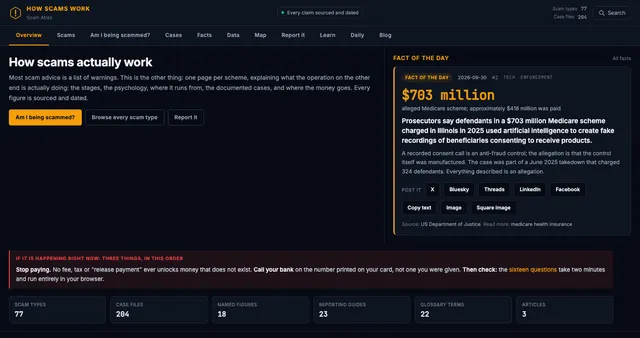
How Scams Work is an educational fraud reference that explains schemes through their stages, psychology, documented cases, reported losses, and movement of proceeds.
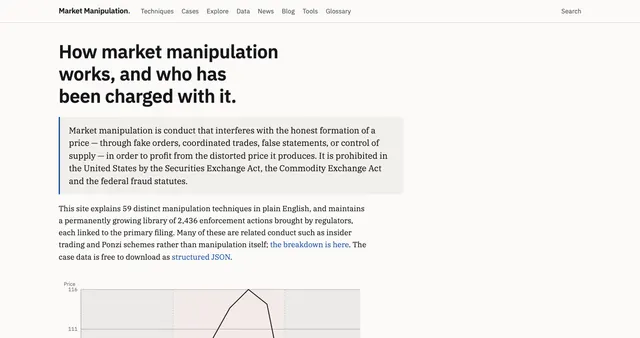
Market Manipulation is an independent educational reference about conduct that distorts price formation and the public enforcement actions associated with financial-market wrongdoing.
Explore site : Market Manipulation Overview of Market Manipulation
We use required browser storage to remember this choice. It is needed for the site to work as intended and is never used for tracking.
If you choose “Accept all”, we also use Google Analytics cookies to count visits and see which pages are useful.
“Accept required” gives you full access to every page. You can change your choice at any time from “Cookie choices” in the footer. Privacy policy