Finance
Clean on Paper
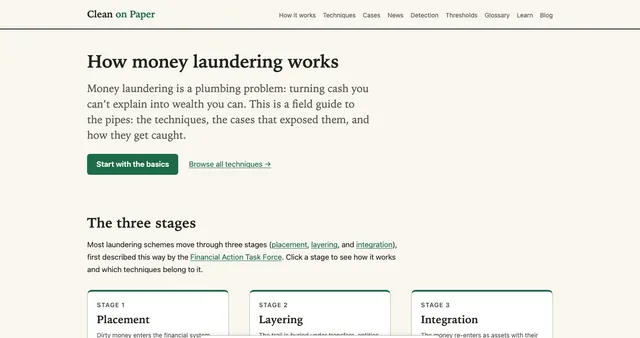
Clean on Paper is an educational reference website about money laundering, organized around how illicit proceeds are disguised and how investigators recognize the process.
Sanctions Evasion is an educational reference website about how attempts to bypass restrictions are recognized and documented.
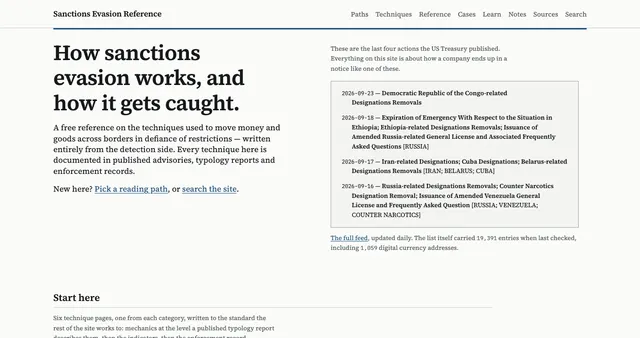
Sanctions Evasion is an educational reference website about how attempts to bypass restrictions are recognized and documented. Its homepage explicitly frames the material from the detection side, drawing on published advisories, typology reports, and enforcement records. The subject is the movement of money, goods, ownership, and obligations across restricted relationships, but the purpose is to help readers understand indicators and public cases rather than provide a manual for evasion. Its navigation includes reading paths, techniques, reference material, cases, learning pages, notes, sources, and search.
The technique catalog covers categories such as corporate concealment, trade and customs, maritime activity, banking and payments, and digital assets. The homepage introduces examples including front companies, misinvoicing, ship-to-ship transfers, third-country transshipment, correspondent banking, and cryptocurrency. Each introduction provides enough context to explain the public typology without supplying operational tooling. The reviewed page described 28 techniques and directed new visitors toward a small set of representative examples written to the standard intended for the wider library. That editorial framing is important to the site's identity.
Reading paths make the reference usable by different audiences. A person learning the subject can start with concepts and glossary terms; a researcher can move toward enforcement datasets, sources, and correction records. Technique pages connect the mechanism with indicators and the relevant enforcement history. Cases and timelines then show how an authority documented particular conduct. This is helpful for journalists, financial-crime students, compliance trainees, trade researchers, and readers trying to understand why a business or vessel appeared in a sanctions announcement.
A designations feed adds current regulatory context. The homepage lists recent Treasury actions and explains that these notices are the type of public record the rest of the site helps readers interpret. It also reports a checked list size and digital-currency-address count. Such numbers are snapshots of a particular source and date, not a global count of sanctioned people or proof that all authorities use the same rules. The feed is a reference entry point; the actual legal measure, jurisdiction, program, and current official text remain decisive.
The about page explains the editorial boundary: material that reads as instruction rather than post-mortem is rewritten. It also describes how factual corrections update page review dates and how material changes are noted. The sources page records publisher, license, update cadence, and last-fetch information from ingestion metadata. Machine-readable outputs include glossary and designations JSON, RSS material, and descriptive files. The site's own text is licensed CC BY 4.0 while cited documents retain their publishers' rights. Vessel-level records are directed to the separate Sanctioned Vessels website rather than being silently duplicated as another authority.
A typical workflow is to encounter a regulatory notice, identify the relevant technique category, inspect the red flags and public case, then open the authority's original record. Readers should avoid inferring wrongdoing simply because a legitimate transaction resembles a described pattern. Restrictions depend on jurisdiction, counterparties, ownership, dates, and the exact activity. The site expressly says it is not legal, compliance, or investment advice. Overall, Sanctions Evasion is a detection-oriented field guide that joins plain-language typologies with documentary evidence. Its strongest contribution is explaining the relationship among mechanisms, indicators, and enforcement findings while retaining an explicit boundary between educational recognition and actionable assistance to repeat the conduct.
A source list for Sanctions Evasion has not been added to this hub yet. Under the network's sourcing principles, every figure on a network site is attributed to a named source.
Clean on Paper is an educational reference website about money laundering, organized around how illicit proceeds are disguised and how investigators recognize the process.
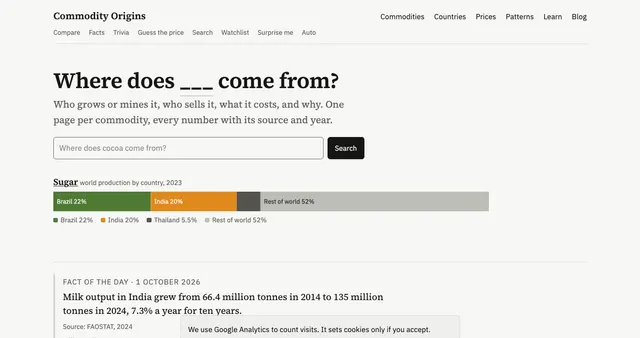
Commodity Origins is a public-data reference website about where commodities are produced, traded, and priced.
Explore site : Commodity Origins Overview of Commodity Origins
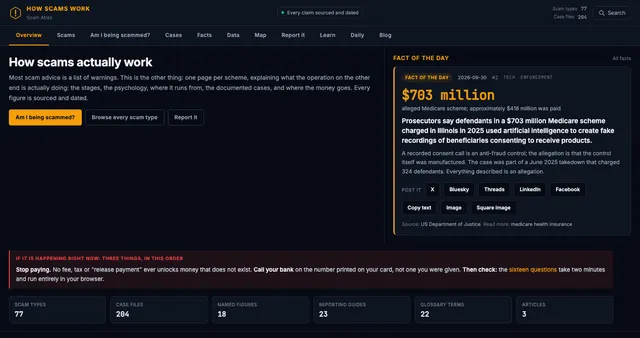
How Scams Work is an educational fraud reference that explains schemes through their stages, psychology, documented cases, reported losses, and movement of proceeds.
We use required browser storage to remember this choice. It is needed for the site to work as intended and is never used for tracking.
If you choose “Accept all”, we also use Google Analytics cookies to count visits and see which pages are useful.
“Accept required” gives you full access to every page. You can change your choice at any time from “Cookie choices” in the footer. Privacy policy