Finance
Clean on Paper
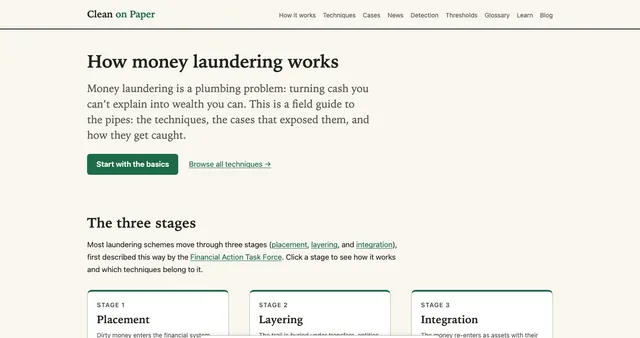
Clean on Paper is an educational reference website about money laundering, organized around how illicit proceeds are disguised and how investigators recognize the process.
Market Manipulation is an independent educational reference about conduct that distorts price formation and the public enforcement actions associated with financial-market wrongdoing.
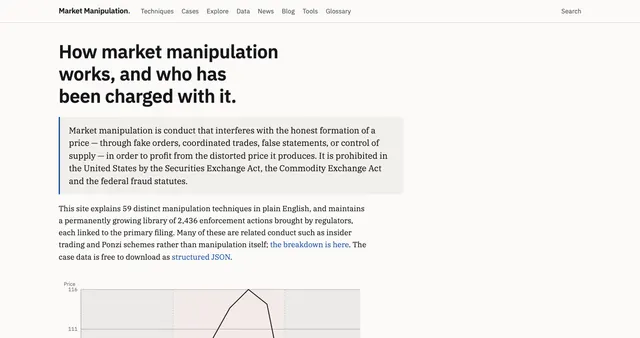
Market Manipulation is an independent educational reference about conduct that distorts price formation and the public enforcement actions associated with financial-market wrongdoing. It explains manipulation through mechanisms such as deceptive orders, coordinated trading, false information, control of supply, and distorted benchmarks. The site combines a technique encyclopedia with a growing case library linked to regulators' primary filings. At the time of review, the homepage advertised 60 techniques and 3,273 enforcement actions. It explicitly notes that the case collection also includes related conduct, such as insider trading and Ponzi schemes, that is not necessarily manipulation in the narrower sense.
The technique library is organized into families based on what the actor controls. Order-book manipulation focuses on orders and trades as the deceptive instrument. Corners and squeezes concern control of supply. Information-based manipulation involves misleading beliefs, while issuer and structural schemes concern the corporate vehicle and share supply. Benchmark and cross-market behavior links activity in one market to gains elsewhere. Crypto-native techniques address features of blockchain markets. Separate crypto and foreign-exchange views cut across those mechanism-based groups rather than serving as interchangeable definitions of the conduct.
This taxonomy is the site's main teaching device. A visitor can learn the difference between behaviors that are often casually lumped together, read a plain-language explanation, and then inspect actual cases. The start-here material introduces the boundaries and includes an exercise with invented scenarios asking whether conduct is manipulation, legitimate trading, or something else. Search, an explorer, agency and year filters, a glossary, and comparison tools help readers move from general concepts to a specific firm, person, statute, or enforcement action.
The case library supports both documentary lookup and broader exploration. The homepage presents totals and penalty summaries, while other sections include regulators, firms involved in several matters, coverage, data charts, machine-readable JSON, a data dictionary, SQLite material, and feeds by regulator or technique. These outputs can support teaching, journalism, compliance research, or data work. A total penalty figure is a catalog summary, however, not necessarily a measure of losses suffered by investors or the full cost of market misconduct. Its interpretation depends on what actions and monetary components the dataset includes.
The editorial material stresses procedural status and corrections. Filed enforcement actions are allegations unless a court or tribunal establishes the conduct. Cases resolved in a respondent's favor are important corrections, not details to bury. The site publishes correction routes and an editorial policy, and it describes its writing, classification, and compiled data as available under CC BY 4.0. Underlying regulator documents remain the primary evidence. This approach makes the product stronger as a guide to public records than as an authority pronouncing guilt from a short profile.
A typical reader might investigate a technique mentioned in the news, compare it with a related but legally different activity, locate an enforcement example, and open the regulator's filing. Educators could use scenario exercises to test whether students understand the boundary between manipulation and ordinary trading. The site is not legal or investment advice and should not be treated as a trading surveillance system. Overall, Market Manipulation is a mechanism-first encyclopedia joined to an evidence-linked enforcement archive. Its distinctive value is making terminology, legal status, and documentary context accessible while resisting the misleading habit of calling every controversial trading practice market manipulation.
A source list for Market Manipulation has not been added to this hub yet. Under the network's sourcing principles, every figure on a network site is attributed to a named source.
Clean on Paper is an educational reference website about money laundering, organized around how illicit proceeds are disguised and how investigators recognize the process.
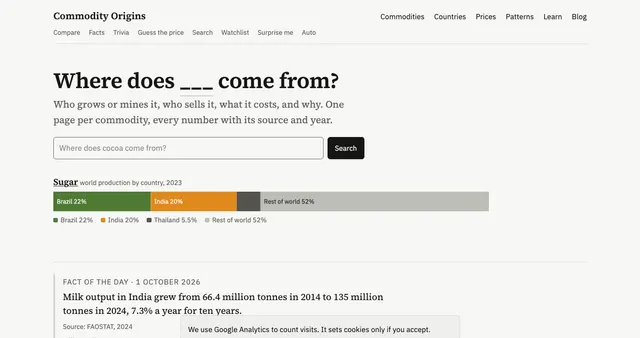
Commodity Origins is a public-data reference website about where commodities are produced, traded, and priced.
Explore site : Commodity Origins Overview of Commodity Origins
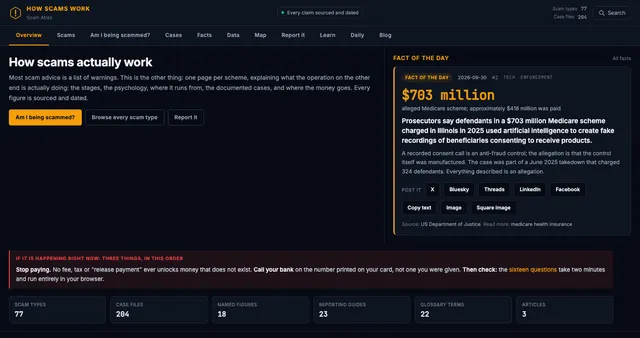
How Scams Work is an educational fraud reference that explains schemes through their stages, psychology, documented cases, reported losses, and movement of proceeds.
We use required browser storage to remember this choice. It is needed for the site to work as intended and is never used for tracking.
If you choose “Accept all”, we also use Google Analytics cookies to count visits and see which pages are useful.
“Accept required” gives you full access to every page. You can change your choice at any time from “Cookie choices” in the footer. Privacy policy