Energy
LNG Atlas
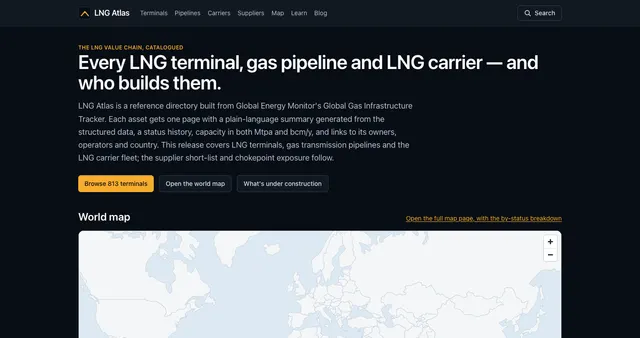
LNG Atlas is a reference directory for the infrastructure of liquefied natural gas and gas transmission.
Nuclear Chain is a reference and data-exploration website about nuclear reactors and the industrial chain that supports them.
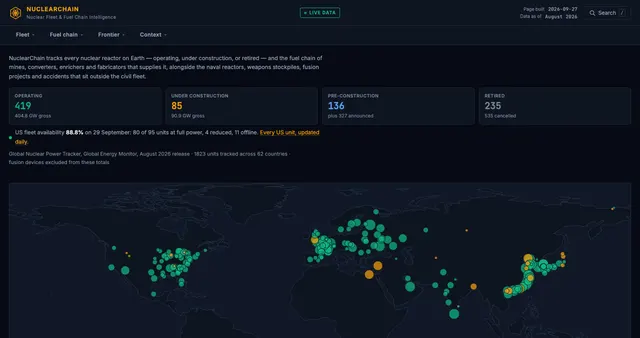
Nuclear Chain is a reference and data-exploration website about nuclear reactors and the industrial chain that supports them. It covers the civil reactor fleet, including operating, under-construction, proposed, retired, and cancelled units, while also providing separately identified material on fuel facilities, advanced designs, fusion, naval propulsion, accidents, and weapons context. The reviewed homepage described 1,823 tracked units across 62 countries using the August 2026 Global Nuclear Power Tracker release from Global Energy Monitor. Its central proposition is that understanding nuclear energy requires both the reactor and the chain of mines, converters, enrichers, fabricators, operators, and storage systems behind it.
The fleet layer supports browsing all reactors, countries, reactor types, design lines, suppliers, large plants, construction projects, fleet age, and historical development. Comparisons and analytical views examine build times, vendor concentration, changing technology mix, reactor sizes, and power uprates. These features make it possible to move from a specific plant to broader questions about industrial capability or the evolution of reactor construction. Gross capacity, unit count, operational status, and site totals are different measures, and the product's organization gives readers several ways to inspect those distinctions rather than reduce the fleet to one headline number.
The fuel-chain layer is especially distinctive. It follows mining, conversion, enrichment, fabrication, interim storage, reprocessing, geological disposal, and depleted uranium. Supplier exposure, HALEU availability, market prices, company ownership, and facility profiles connect the technical process to industrial concentration. A reader interested in an advanced reactor can therefore investigate not only its proposed design but whether the required fuel pathway exists at the necessary stage. This makes the site useful to energy writers, students, policy researchers, and people studying nuclear supply chains.
Some sections add current or near-current public feeds. United States daily reactor status comes from the NRC, while other pages collect outages in supported countries, earthquakes near plants, weekly developments, alerts, and data-freshness indicators. These feeds should be distinguished from the baseline global tracker snapshot. A live outage record does not imply that every reactor profile or fuel-facility record updates at the same cadence. Earthquake proximity also describes geographic association rather than proof of damage or a safety finding. The freshness dashboard is therefore part of interpreting the content, not merely a technical accessory.
The site explicitly separates fusion devices from fission fleet totals and states that fusion has not delivered net electricity to a grid. Advanced-reactor and microreactor sections are organized around evidence such as regulator action rather than treating every announcement as an operating asset. Its about-and-method material records source discrepancies and corrections, including conflicts over grid-connection and commercial-operation dates. Unknown or disputed values require attention to those notes. Data exports, an API reference, changelog, source links, and machine-readable material support checking and reuse.
A practical visit might begin with a plant, inspect its units and design, follow its suppliers, and compare the associated fuel-chain exposure with another country's fleet. An educator might instead use the explainers to connect reactor technology with the nine-stage industrial chain. Overall, Nuclear Chain combines a reactor atlas with an industrial and historical reference. Its strongest contribution is showing nuclear infrastructure as a connected system while keeping civil totals, speculative projects, live status feeds, and wider nuclear topics sufficiently separate to avoid treating all of them as equivalent operational capacity.
A source list for Nuclear Chain has not been added to this hub yet. Under the network's sourcing principles, every figure on a network site is attributed to a named source.
LNG Atlas is a reference directory for the infrastructure of liquefied natural gas and gas transmission.
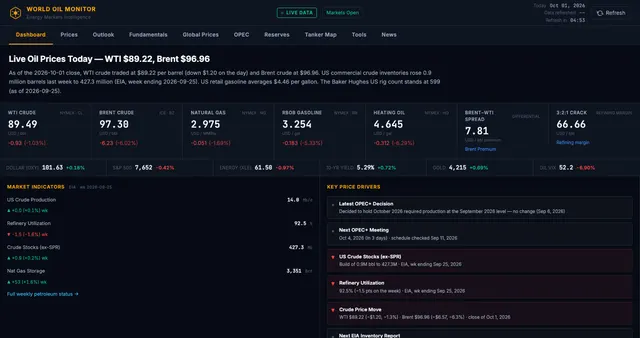
World Oil Monitor is an energy-market dashboard and reference website focused on oil prices, petroleum fundamentals, related fuels, and the wider industrial context of energy markets.
Explore site : World Oil Monitor Overview of World Oil Monitor
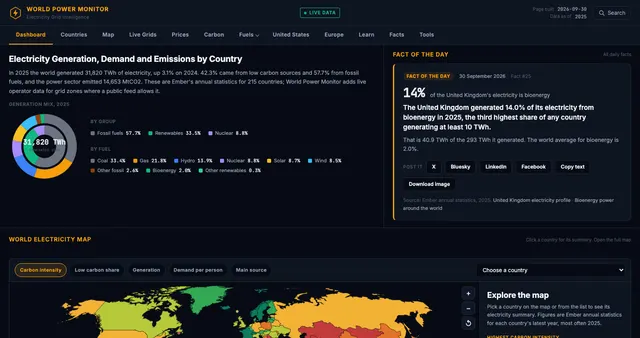
World Power Monitor is an electricity data website that combines country-level generation and emissions statistics with live operator feeds where public data is available.
Explore site : World Power Monitor Overview of World Power Monitor
We use required browser storage to remember this choice. It is needed for the site to work as intended and is never used for tracking.
If you choose “Accept all”, we also use Google Analytics cookies to count visits and see which pages are useful.
“Accept required” gives you full access to every page. You can change your choice at any time from “Cookie choices” in the footer. Privacy policy