Energy
Nuclear Chain
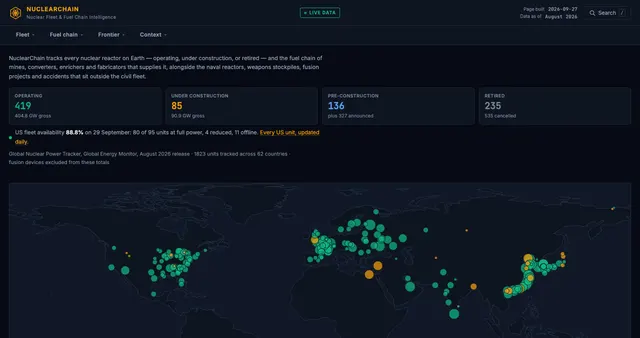
Nuclear Chain is a reference and data-exploration website about nuclear reactors and the industrial chain that supports them.
LNG Atlas is a reference directory for the infrastructure of liquefied natural gas and gas transmission.
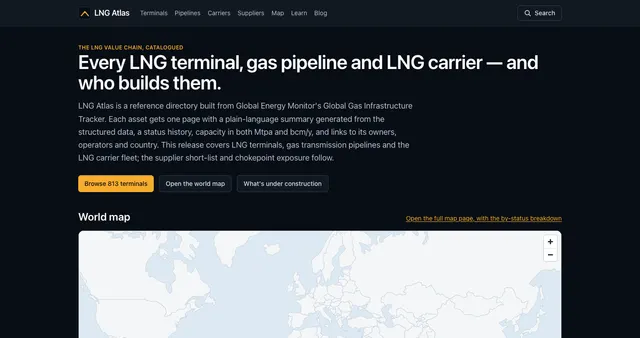
LNG Atlas is a reference directory for the infrastructure of liquefied natural gas and gas transmission. It connects LNG terminals, gas pipelines, carrier vessels, owners, operators, countries, and selected industrial context in one navigable system. Its core data is based on Global Energy Monitor's Global Gas Infrastructure Tracker, with named releases and license information. The reviewed homepage advertised 813 terminal pages, 4,246 pipelines, 1,220 carrier records, and 2,503 companies across 156 countries. These are catalog figures with different counting units, not a single simultaneous inventory of operating capacity.
Each asset gets a stable page with a plain-language summary generated from structured data. Terminal pages retain status history and capacity in both million tonnes per annum and billion cubic metres per year. Owner, operator, and country links connect a project to related assets rather than leave it as an isolated spreadsheet row. Visitors can browse operating infrastructure, construction projects, proposals, cancelled or shelved units, and the carrier order book. A map offers geographic exploration of terminals and pipeline routes, with status, country, and terminal-type controls.
The method distinguishes projects from their component units. A terminal can contain one operating train and several units under construction; its page can therefore have an operating overall status while separating operating and construction capacity. The methodology describes status normalization, keeps unrecognized source values visible, and leaves absent capacity unestimated. Unit conversion follows a published convention of 1 Mtpa to 1.36 bcm per year when one of those fields is missing. These rules matter because a headline terminal count, a train count, and an operating-capacity total answer different questions.
Pipeline handling is similarly careful. Source segments are grouped into project pages, and repeated project-level lengths or capacities are not blindly summed. Where segment figures genuinely differ, the method can sum them; where a project-level figure repeats, it is counted once and labelled. Geometric length estimates are identified as such when no reported length exists. This makes the directory particularly useful for readers who want to understand infrastructure totals without unintentionally double-counting segmented records. The public method is as important as the visual map.
The homepage highlights large operating terminals, major construction projects, long pipeline systems, large carrier hulls, and country distributions. Rankings, comparisons, explainers, a glossary, unit conversion, coverage notes, data downloads, and change material provide further context. Supplier and chokepoint sections appear in navigation, but the reviewed homepage also labels some supplier and exposure material as forthcoming. Those planned areas should not be described as fully complete simply because a menu link exists. It explicitly says vessel positions are not tracked, distinguishing the carrier directory from an AIS monitoring service.
A typical user might start with a country, inspect its import terminals and owners, follow a construction project, and compare reported capacity with another site. Energy journalists, students, infrastructure researchers, and supply-chain observers are natural audiences. Source vintages and project status changes require attention before using the catalog for a current investment or operational decision. Overall, LNG Atlas is an accessible map of the gas value chain, built to transform spreadsheets into linked reference pages. Its distinctive contribution is transparent asset grouping, explicit capacity and status rules, and connections between projects, companies, geography, and fleet records rather than a claim to live cargo or vessel intelligence.
A source list for LNG Atlas has not been added to this hub yet. Under the network's sourcing principles, every figure on a network site is attributed to a named source.
Nuclear Chain is a reference and data-exploration website about nuclear reactors and the industrial chain that supports them.
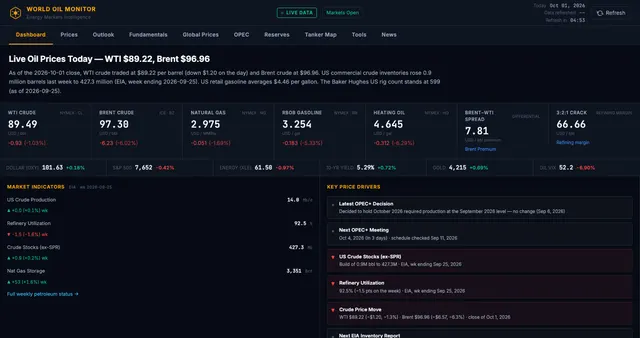
World Oil Monitor is an energy-market dashboard and reference website focused on oil prices, petroleum fundamentals, related fuels, and the wider industrial context of energy markets.
Explore site : World Oil Monitor Overview of World Oil Monitor
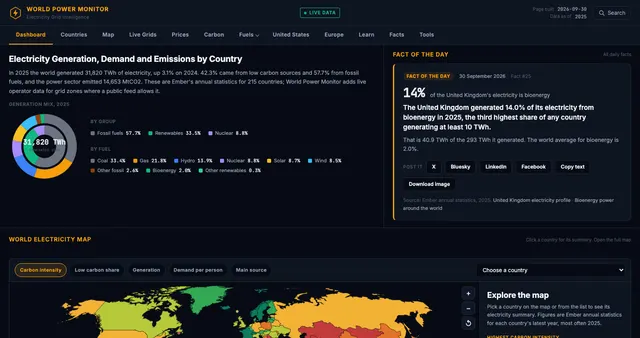
World Power Monitor is an electricity data website that combines country-level generation and emissions statistics with live operator feeds where public data is available.
Explore site : World Power Monitor Overview of World Power Monitor
We use required browser storage to remember this choice. It is needed for the site to work as intended and is never used for tracking.
If you choose “Accept all”, we also use Google Analytics cookies to count visits and see which pages are useful.
“Accept required” gives you full access to every page. You can change your choice at any time from “Cookie choices” in the footer. Privacy policy