What you can do here
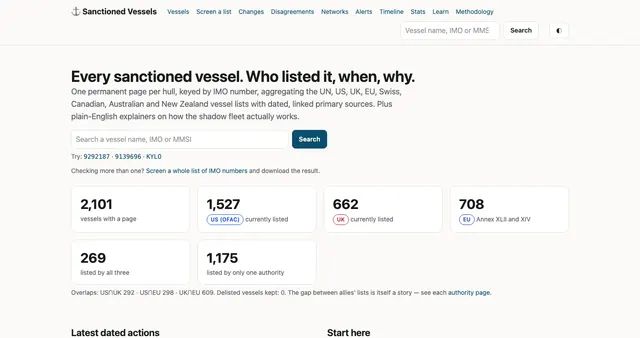
Sanctioned Vessels is a maritime sanctions reference that gives each listed hull a permanent page keyed by IMO number. Its central purpose is to make official vessel designations easier to find, compare, and understand without hiding the original authority or source date. It aggregates vessel-related lists from the United Nations, United States, United Kingdom, European Union, Switzerland, Canada, Australia, and New Zealand. The reviewed homepage showed 2,128 vessel pages and separate counts for major authorities, overlaps, and vessels listed by only one authority. Those figures are snapshot summaries, not interchangeable statements that every vessel is sanctioned everywhere.
Search accepts vessel names, IMO identifiers, and MMSI values. Using the IMO number as the stable organizing key helps connect a hull through name or flag changes. Directory filters cover authority, flag, type, size, and first-sanction year, while a bulk screening interface lets readers check a list of IMO numbers and download results. Changes, disagreements, networks, alerts, timelines, and statistics provide other routes into the records. These tools are useful to journalists, port agents, insurers, students, and compliance researchers who need an initial view of a vessel's public listing history.
The distinction between authorities is a defining feature. The homepage highlights how many ships appear on multiple lists and how many appear on just one. It also explains that some European Union vessel entries represent port and service restrictions rather than an asset freeze, and that not all relevant annexes appear in the financial sanctions file. This prevents a simplistic sanctioned-or-not answer from erasing the actual type of restriction. Ukraine's vessels-of-concern material is displayed separately as a catalogue, not treated as a legal designation by one of the eight ingested authorities.
Dated actions and source freshness are visible. The homepage separates the most recent published action from the last time lists were checked, explaining that a quiet period does not mean collection has stopped. The methodology describes nightly refreshes and checksum-preserved source files, which support reproducing a historical snapshot. Primary links are retained so that users can inspect the official notice or list. Alerts and feeds provide ways to follow a hull or company without repeatedly scanning the entire directory.
The explanatory layer introduces shadow-fleet concepts such as flags of convenience, ownership layers, ship-to-ship transfers, price-cap attestations, and the interpretation of sanctions listings. This supplies context for a reader arriving from a tanker news story. It does not make behavior findings about a vessel merely from a suspicious pattern. The reviewed methodology explicitly said behavior signals and incidents were not yet included, and it identified excluded sources such as Japan's non-consolidated, vessel-unstructured publications rather than guessing their contents.
The site states that it is independent, restates what authorities publish, and does not make its own findings of wrongdoing. It is not legal advice or a screening tool of record; consequential compliance decisions require the official lists and appropriate professional judgment. A useful workflow is to search an IMO, examine which authority listed the hull and under what measure, inspect the dated source, and confirm the current official position. Overall, Sanctioned Vessels fills the gap between raw government documents and paid maritime intelligence. Its greatest value is the stable hull-based record and explicit handling of disagreement, scope, restriction type, and freshness rather than a misleading single global sanctions flag.
Sources
A source list for Sanctioned Vessels has not been added to this hub
yet. Under the network's sourcing principles, every figure on a
network site is attributed to a named source.