
Nutrition
Supplment Label Index
Supplement Label Index is a market-level analytics website about what United States dietary supplement labels declare.
Explore site : Supplment Label Index Overview of Supplment Label Index
Food Additive Index is a structured reference website about food additives, their identities, and how regulators treat them.
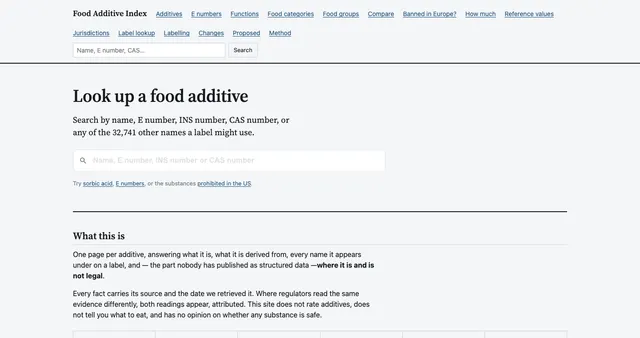
Food Additive Index is a structured reference website about food additives, their identities, and how regulators treat them. It is designed to answer questions that ordinary ingredient lists rarely resolve: what a substance is, which names or identifiers it uses, what it is derived from, and where a particular use is permitted, restricted, or not listed. The reviewed homepage advertised 996 additives, 62,807 regulatory provisions, eight jurisdictions, 32,654 indexed names, 748 food categories, and 516 reference values. Those numbers describe the site's compiled coverage and should not be treated as a guarantee that every possible food use or national rule is included.
Search accepts common names, E numbers, INS numbers, and CAS numbers. This identity layer is important because the same substance can appear under different chemical, commercial, regional, or language-specific labels. An additive page provides a stable place to connect those aliases with source-linked regulatory records. Visitors can also browse by function, food category, food group, jurisdiction, or identifiers. A label-lookup interface lets readers paste an ingredients list or use a photograph; the homepage states that the image is read on the user's device.
The central distinction is between regulatory status and a health verdict. The site explicitly says it does not rate additives, tell readers what to eat, or declare a substance safe. When regulators interpret evidence differently, their positions are shown with attribution. A missing listing does not automatically mean a prohibition, and permission in one food category does not imply unrestricted use everywhere. Comparison pages, jurisdiction explanations, and glossary material help readers understand positive lists, GRAS, carry-over, good manufacturing practice, and quantum satis without collapsing them into a simplistic approved-versus-banned label.
Quantity and labeling are separate research paths. The site explains the forms a permitted amount can take and where regulators set different ceilings. It also collects statements an additive requires on packaging and links them to the relevant legal instrument. Derived-from pages cover plants, animals, insects, fermentation, minerals, and petrochemical feedstocks, while allergen-origin material describes possible or documented connections with listed allergens. These distinctions can help a reader interpret a label, but they do not establish the actual origin of every manufacturer's batch or replace product-specific allergy advice.
Its provenance is unusually detailed. The homepage identifies sources including eCFR, Codex and JECFA materials, European Commission and EUR-Lex records, EFSA OpenFoodTox, United Kingdom registers, Health Canada, Australian legislation, Japanese legal sources, South Korean rules, FDA GRAS notices, and PubChem. It also states the applicable licensing or reuse terms and directs visitors to retrieval dates. Method, specifications, instruments, proposed changes, unmatched names, API, bulk data, and feed links support both documentary checking and developer use.
A typical visitor could search an unfamiliar ingredient, identify its aliases, inspect the permitted uses for a chosen jurisdiction, and open the primary provision before drawing a conclusion. Food researchers, label readers, journalists, formulators, and regulatory professionals are plausible audiences. Legal texts and assessment dates can change, so a consequential decision should use the current official instrument rather than rely solely on a compiled page. Overall, Food Additive Index is a regulatory and identity atlas, not a wellness-rating service. Its distinctive value is structuring the difficult connections among substances, names, food uses, limits, jurisdictions, and evidence while keeping regulatory disagreement and the meaning of missing data explicit.
A source list for Food Additive Index has not been added to this hub yet. Under the network's sourcing principles, every figure on a network site is attributed to a named source.
Supplement Label Index is a market-level analytics website about what United States dietary supplement labels declare.
Explore site : Supplment Label Index Overview of Supplment Label Index
We use required browser storage to remember this choice. It is needed for the site to work as intended and is never used for tracking.
If you choose “Accept all”, we also use Google Analytics cookies to count visits and see which pages are useful.
“Accept required” gives you full access to every page. You can change your choice at any time from “Cookie choices” in the footer. Privacy policy