
Auto Recall Watch
Auto Recall Watch is a vehicle research website that organizes safety recalls and owner complaint reports by make, model, and model year.
What you can do here
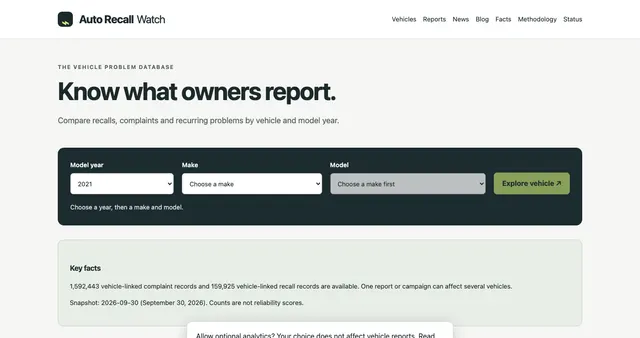
Auto Recall Watch is a vehicle research website that organizes safety recalls and owner complaint reports by make, model, and model year. Its starting point is a practical question: what problems have people reported for this particular vehicle, and which recall campaigns are on record? The homepage invites visitors to choose a model year, manufacturer, and model before exploring the relevant evidence. Its directory extends beyond familiar passenger-car brands to include commercial vehicles, motorcycles, buses, trailers, recreational vehicles, and specialist manufacturers. That broad scope makes it a public-record interface rather than simply a consumer car-review publication.
The site separates vehicle pages from reports, research, news, blog material, daily facts, methodology, and data status. This structure supports both narrow lookups and wider exploration. A prospective used-car buyer could inspect complaints associated with a specific model year; a current owner could investigate a recurring component issue; and a researcher could examine patterns across years. Exact names and variants remain separate in the directory, an important qualification when a manufacturer uses similar branding for different vehicles or configurations. The website should not be assumed to identify an individual vehicle's recall completion status from a model lookup alone.
Its methodology explains that complaints are deduplicated using ODI numbers and recalls using NHTSA campaign numbers. A single complaint can identify several components, so component totals can exceed the number of unique reports. This prevents a common misreading in which several categories are mistaken for several independent incidents. The site also retains filing dates and source snapshot dates, making clear that the compiled material is not an uninterrupted live stream of defects. A recently built page and a recent complaint are different things.
The vehicle analysis explorer adds descriptive tools such as component heatmaps, mileage ranges, co-occurrence counts, monthly filing charts, and equal-age comparisons across model years. Mileage percentiles require enough usable records, while equal-age curves compare completed observation windows rather than letting older vehicles accumulate more time without qualification. The methodology publishes a rule for screening recent complaint spikes but explicitly says the rule is not a statistical significance test or a defect finding. Narrative pattern cards likewise expose their keyword rules and selected source examples instead of treating text matches as conclusive diagnosis.
These details make the site useful for investigating a question before consulting original records, an automotive professional, or the manufacturer. A typical workflow is to choose a vehicle, inspect recalls and complaints, look for repeated components or time patterns, and then follow the relevant official campaign or report. The research and explanatory sections help visitors understand why filing volume, incident timing, mileage, and model-year age are not interchangeable measures. Selected narratives can provide context, but they are not representative samples of all owners' experiences.
The most important limitation is that complaint counts do not directly measure failure probability. The published method says the analysis does not correct for sales exposure, total mileage, or reporting delays. Missing fields, reporting habits, variant naming, and incomplete calendar years can affect comparisons. A heavily sold vehicle can attract more reports without necessarily being less reliable per vehicle. Overall, Auto Recall Watch is best described as an accessible vehicle problem-record explorer: valuable for surfacing documented concerns and understanding source material, but not a substitute for a VIN-specific official recall check, a mechanical inspection, or a causal reliability study.
Sources
A source list for Auto Recall Watch has not been added to this hub yet. Under the network's sourcing principles, every figure on a network site is attributed to a named source.