
Aviation
AirlineNation
AirlineNation is an aviation reference website that brings together operating and defunct airlines in a single searchable historical directory.
Airline Fleet Monitor is an aviation reference and telemetry website that connects airline fleet information with open ADS-B observations, civil aircraft registers, and other public aviation sources.
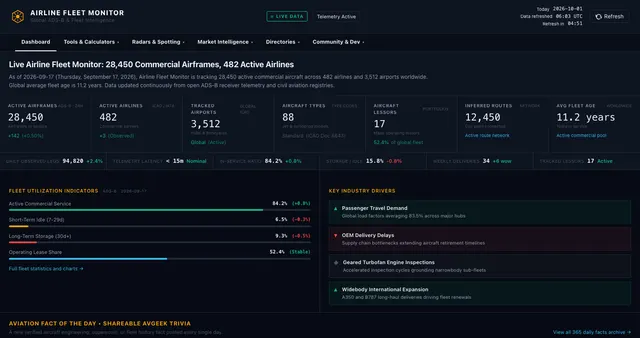
Airline Fleet Monitor is an aviation reference and telemetry website that connects airline fleet information with open ADS-B observations, civil aircraft registers, and other public aviation sources. It aims to show commercial aircraft as operating machines rather than only as entries in a manually maintained fleet list. The site combines airline profiles, airframe records, aircraft families, airport and route references, market intelligence, and map-based viewing. Its central audience is people researching airline equipment and aviation activity, including enthusiasts, writers, planespotters, and industry observers. It is not a flight-dispatch system or a guarantee of an aircraft's current position.
The reviewed navigation is unusually broad. Airline directories, country aviation markets, defunct-carrier archives, fleet-age leaderboards, aircraft types, lessors, alliances, and airport hubs provide the reference layer. Radar sections offer live ADS-B maps, high-density flight vectors, assembly observations, and factory rollout material. Delivery comparisons, OEM order backlogs, freighter fleets, commercial engine information, and weekly movements connect the catalog to the business of building, financing, and operating aircraft. Readers can therefore approach the site through a carrier, a specific airframe, an aircraft family, or a market question.
Cabin and passenger-facing information forms another layer. The interface includes seat-pitch and comfort comparisons, cabin configuration material, in-flight Wi-Fi coverage, and special livery tracking. VIP and government fleets, flight-test aircraft, vintage active jets, airworthiness directives, incidents, and airport night curfews extend coverage into specialized subjects. These topics help explain that a fleet is not simply a total aircraft count: age, configuration, engine choice, ownership, cargo role, and operating restrictions all affect what that number means.
The site also advertises 29 aviation tools and calculators. Visible examples include great-circle and jet-stream flight-time estimates, METAR decoding, ETOPS diversion mapping, runway crosswind resolution, density-altitude and takeoff-distance calculations, direct operating cost and fuel models, fleet comparisons, cabin density, emissions, lease estimates, and retirement-risk models. Their practical value is educational exploration of assumptions and relationships. They should not be read as approved performance data, dispatch instructions, certified valuation reports, or substitutes for aircraft manuals and professional judgment.
The footer attributes data to OpenSky Network, civil aviation registries, ICAO aircraft designators, OpenFlights, Aviation Safety Network, and OEM order books. It explicitly describes fleet observations as indicative and derived from open telemetry and register records. That is an important limitation: receivers have geographic and temporal gaps, registration information can lag operational changes, and an observed aircraft count is not always an airline's full owned or leased fleet. A static homepage indicator also showed an older telemetry date, reinforcing the need to inspect the timestamp of the particular feed rather than rely on live branding alone.
A useful journey is to search for an airline, examine its types and observed airframes, compare another carrier, and then follow the named source for a consequential fact. A planespotter might instead use radar and a digital logbook to connect sightings with airframe identity. Overall, Airline Fleet Monitor is a wide-ranging aviation intelligence interface built around public reference data and observations. Its strongest contribution is the connection between carriers, aircraft, operations, and industry context, with enough tools to explore the relationships while keeping its informational, non-operational status clearly in view.
A source list for Airline Fleet Monitor has not been added to this hub yet. Under the network's sourcing principles, every figure on a network site is attributed to a named source.
AirlineNation is an aviation reference website that brings together operating and defunct airlines in a single searchable historical directory.
Boeing-747.com is an independent enthusiast reference devoted to the Boeing 747's history, variants, specifications, operators, and continuing roles.
We use required browser storage to remember this choice. It is needed for the site to work as intended and is never used for tracking.
If you choose “Accept all”, we also use Google Analytics cookies to count visits and see which pages are useful.
“Accept required” gives you full access to every page. You can change your choice at any time from “Cookie choices” in the footer. Privacy policy